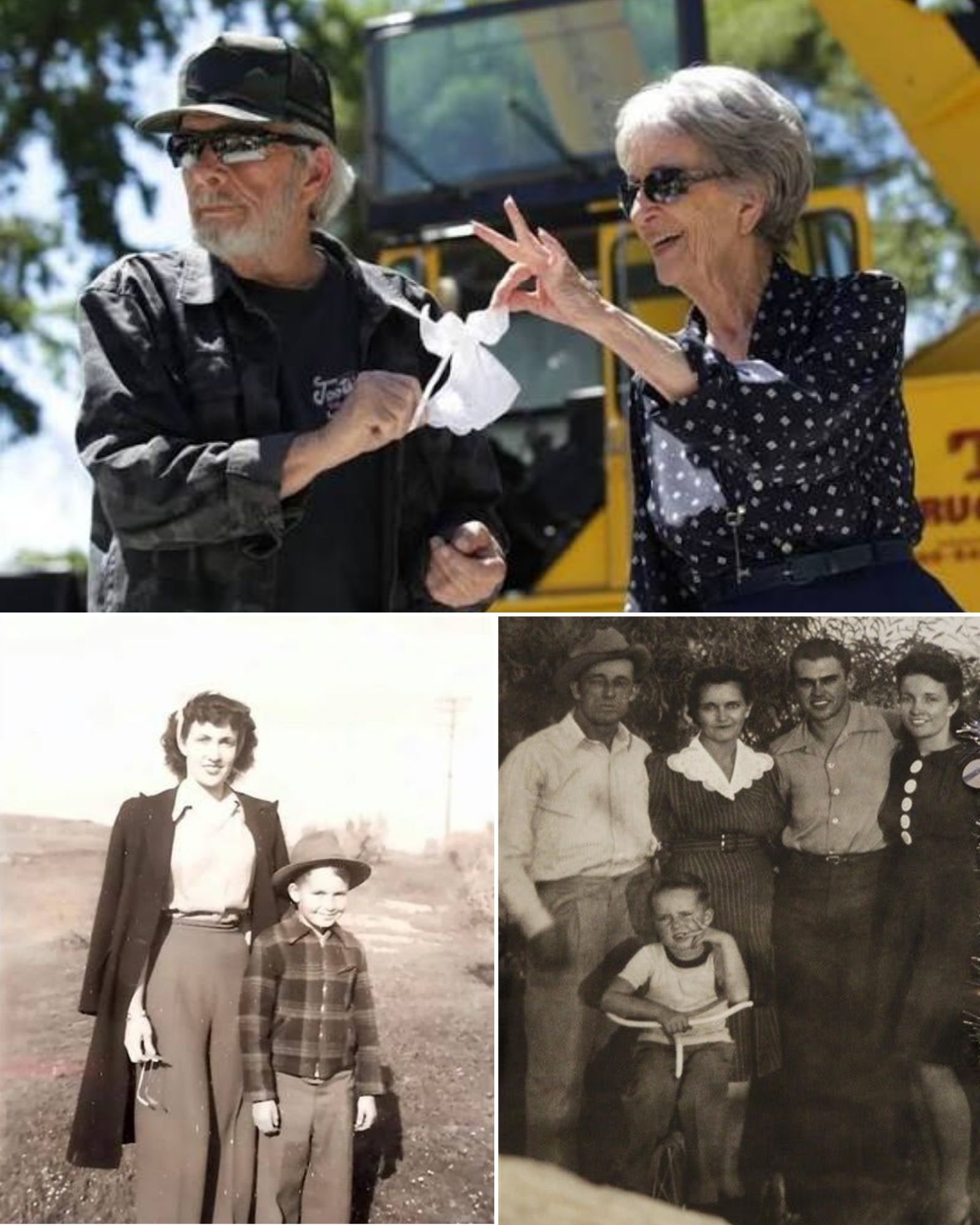
On a spring day in 2003, Merle Haggard stood in Washington, D.C., on a 40-foot section of genuine Route 66. The Oklahoma Department of Transportation had given that piece of highway to the Smithsonian’s National Museum of American History, and it became the stage for one of the most personal moments of Merle Haggard’s life.
He was not there to sing. He was there with his older sister, Lillian, to sign over the belongings their parents had carried west on that same road in 1935.
How the Smithsonian Found the Haggards
The museum was building a major new exhibition called America on the Move, about how transportation shaped American life. One of its centerpieces would be Route 66. A researcher on the project came across one of Merle Haggard’s autobiographies and realized his family’s story belonged in that section.
The museum called Merle Haggard’s agent. The agent pointed them to someone else: Lillian. She was the family historian, the one who had kept the things nobody else thought to keep.
What Came Out of the Boxes
None of it looked like museum material at first glance. There was a trunk. There was a lamp. There were quilts. There was a camera that Flossie Haggard had carried on the trip.
And there was a Singer sewing machine. Flossie had bought it used for ten dollars in 1931, and when the family left Oklahoma, it rode west with them in the car and trailer. For a family that had lost almost everything, a working sewing machine meant clothes could still be mended and made.
These were ordinary household things. That was exactly why the Smithsonian wanted them. They showed what a real family chose to save when there was only room for so much.
The Fire That Sent Them West
James and Flossie Haggard had been making a living on a 40-acre farm they leased near Checotah, Oklahoma. Then fire swept through. In Merle Haggard’s own telling, it took the barn, the wagon, the plows, the cows, the horses, and his father’s prized Model A Ford.
James Haggard walked to town to find another car. He came home with a 1926 Chevrolet and a small homemade trailer behind it. The family gave up the lease, packed what they had, and headed west in 1935. Lillian was 14. Her brother Lowell was 12. Merle had not been born yet.
They did not make the trip entirely alone. Flossie’s sister had already moved to California a couple of years earlier, and she sent them $40 to help. In 1935, that was real money.
A Boxcar That Was Supposed to Be Temporary
The family settled in Oildale, just outside Bakersfield. James Haggard found work with the Santa Fe Railway, and the couple bought an old wooden Santa Fe refrigerator boxcar for $500, paying it off at ten dollars a month. They moved in on September 15, 1935.
James Haggard turned it into a home. The living room, kitchen and bathroom were built inside the boxcar itself, and he added a front bedroom, a screened back porch and a breakfast nook. Flossie planted fruit trees, climbing roses and a grape arbor.
The plan was to live there only until they could build a bigger house on the lot. Then, on April 6, 1937, Merle Ronald Haggard was born, and the plans changed. The temporary home became the house he grew up in.
What Merle Said That Day
At 66, with nearly four decades on the road behind him, Merle Haggard talked about his parents in front of the cameras. He admitted he sometimes wondered what it had all been about. He spoke of his father, and of finally becoming a man he believed James Haggard would have been proud of.
That was not a small thing. His father died when Merle was nine, and the boy’s life went off the rails soon after. Merle told the crowd that he had traveled Route 66 himself at 14, hitchhiking east from California, chasing something he could not even name, while his mother had no idea where he was.
Then he said the line that tied it all together. Every time he traveled, he said, he thought about his mother and father and the way they had made their own trip.
Asked whether he ever imagined being honored at the Smithsonian, he laughed and said it was beyond his wildest dreams. His only regret, he said, was that his mother and dad were not there to see it.
Lillian Set the Record Straight
Lillian Haggard Hoge, then 81, had her own message for anyone in the room ready to picture the Haggards as a ragged Dust Bowl family out of a sad old photograph.
We were not poor.
She did not deny the hard times. But she rejected the idea of Dust Bowl migrants as uneducated, homeless drifters, calling that picture fiction. She said she had never thought of herself as a hillbilly.
Her brother understood the sting of those labels. He recalled that being called an Okie had once been a cruel insult in California, the very word he would later turn into a proud anthem.
Lillian also kept the day light. When a reporter tried to pull Merle into politics, she jumped in with a laugh and warned that they did not have that much time.
A Family Story in the Nation’s Museum
When America on the Move opened that November, the Haggard family’s trip took its place beside locomotives, early automobiles and that slab of the Mother Road. Merle Haggard supplied the fame that brought people to look. Lillian and their mother had supplied the proof: a trunk, a lamp, a sewing machine, quilts and a camera that had seen the road west.
Does your family still have something that made a long journey like that? Maybe a trunk, a quilt or an old photograph nobody wants to throw away. We would love to hear its story.