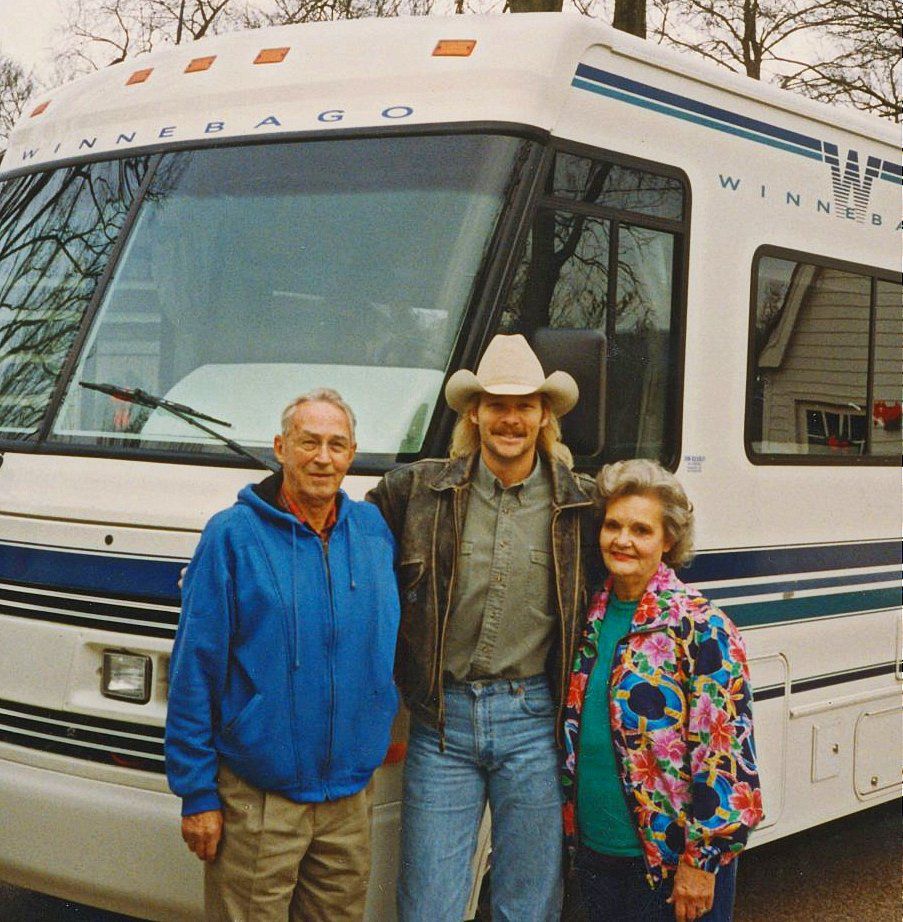
When Alan Jackson released “Small Town Southern Man” in late 2007, country fans heard a familiar story about a hardworking father, a devoted husband, and a family raised on simple Southern values.
But hidden in that familiar story were details that closely resembled Alan Jackson’s own childhood.
Four daughters. A younger son. A modest home in Georgia. A father who worked with his hands and believed that family mattered more than money.
Alan Jackson had grown up knowing a man just like that. His name was Joseph Eugene Jackson, affectionately known as Daddy Gene.
And it was only after Daddy Gene died that Alan Jackson discovered how much his father had meant to people outside their family.
A Family That Started With Almost Nothing
In 1946, Eugene Jackson married Ruth Musick, the young woman who would become known to Alan Jackson’s fans as Mama Ruth.
The newlyweds had little money and no spacious house waiting for them.
Instead, they began married life in a 12-by-12-foot tool shed that Ruth’s father had built. The little structure was moved on logs onto a nearby piece of family land in Newnan, Georgia.
As the family grew, so did the house.
First came four daughters: Diane, Cathy, Carol, and Connie. Then, on October 17, 1958, Alan Jackson arrived as the youngest child and only son.
Even after years of additions, the family home remained crowded. Alan Jackson later recalled sleeping in the hallway until the age of ten, when an older sister left for college.
Yet that modest house became one of the most important places in Alan Jackson’s songwriting. Years before “Small Town Southern Man,” Alan Jackson had already written about the family’s beginnings in the song “Home.”
The Mechanic Who Helped His Neighbors
Daddy Gene worked as a mechanic at a Ford Motor Company assembly plant in Atlanta. But the workday often continued after Daddy Gene returned home.
Behind the family house was a garage where Daddy Gene repaired cars for neighbors, sometimes on weekends.
Not everyone paid with money.
Alan Jackson remembered that Daddy Gene occasionally accepted things such as lawn mowers in exchange for fixing a vehicle.
One particularly unusual trade involved an orange street sweeper with a large rotating brush.
Alan Jackson remembered driving the machine around the family’s unpaved yard, stirring up clouds of Georgia dirt.
These were ordinary childhood memories. Yet they also revealed a father who was willing to use his skills to help people, even when the reward was something other than a paycheck.
When Alan Jackson later decided to pursue music in Nashville, Daddy Gene supported the decision. Daddy Gene reassured Alan Jackson that returning home would always be an option.
The Day Alan Jackson Saw His Father Differently
Daddy Gene died in January 2000, at the age of 72.
At the funeral in Newnan, Alan Jackson witnessed something unexpected.
People kept arriving to pay their respects.
These were people who had known Daddy Gene through work, friendship, neighborhood life, and the countless ordinary encounters that make up a person’s years in a small town.
Alan Jackson was surprised by how many people had come.
In a 2010 interview, Alan Jackson explained that the funeral revealed how deeply Daddy Gene had touched other people’s lives. A man who had never been famous had quietly earned an extraordinary amount of respect.
The experience changed Alan Jackson’s understanding of his father.
Alan Jackson came to appreciate that kindness, generosity, and the way someone treats others can leave a legacy that money and recognition cannot measure.
Those lessons would stay with Alan Jackson long after the funeral.
Two Songs, Two Ways of Remembering Daddy Gene
In 2002, Alan Jackson released “Drive (For Daddy Gene),” a deeply personal song remembering childhood adventures with his father, including time spent around an old truck and a boat.
That song was explicitly written in Daddy Gene’s memory.
“Small Town Southern Man,” released in 2007, approached the subject differently.
Alan Jackson explained that the later song was not intended as a specific tribute to Daddy Gene or Alan Jackson’s grandfather. Instead, it honored hardworking rural families whose values and experiences were similar to those Alan Jackson had known growing up.
Still, the resemblance was unmistakable.
The song’s family of four daughters followed by a younger boy echoed Alan Jackson’s own family. Its picture of a man devoted to his wife, children, and home reflected the world that had shaped Alan Jackson.
“Small Town Southern Man” eventually reached No. 1 on Billboard’s country chart in 2008.
What Daddy Gene Really Left Behind
Daddy Gene never needed a famous name to make a difference in Newnan.
Daddy Gene had spent a lifetime working, raising children, repairing cars, and helping people in familiar, unremarkable ways.
Only at the funeral did Alan Jackson fully recognize how far those small acts had reached.
And perhaps that is why “Small Town Southern Man” continues to resonate with listeners. The song does not have to be about one particular father to remind thousands of people of their own.
For Alan Jackson, the connection was especially personal. Daddy Gene left behind more than a house, a family, or memories of a garage in Georgia.
Daddy Gene left behind the respect of a community and a way of living that Alan Jackson would carry into some of country music’s most memorable songs.