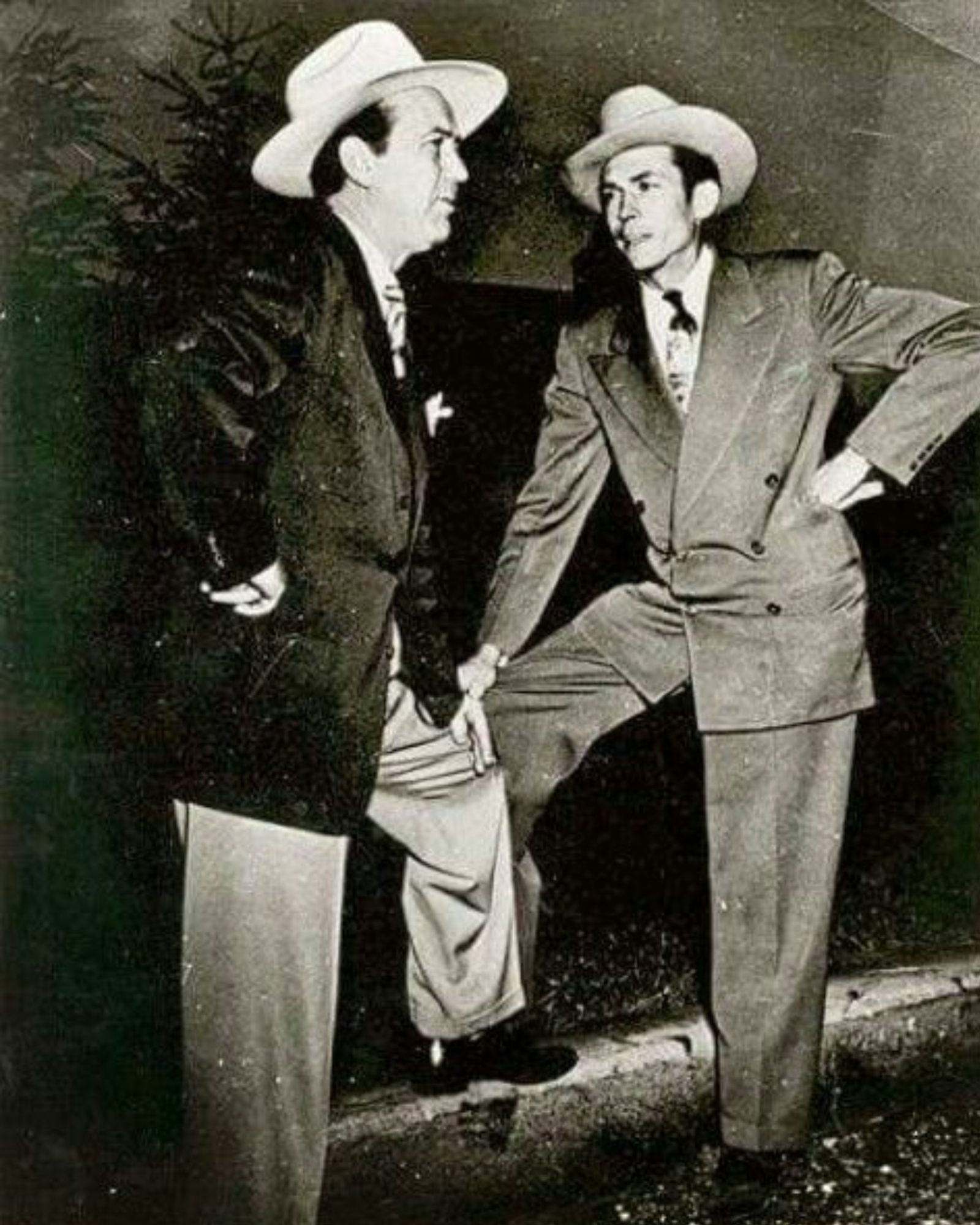
Some songs follow a person through life. For Red Foley, that song was “Peace in the Valley.” He sang it to say goodbye to his friend Hank Williams in 1953. Fifteen years later, on a September night in Indiana, he sang it one final time, with Hank’s son standing nearby.
Mr. Country Music
Clyde Julian “Red” Foley was born on June 17, 1910, in Blue Lick, Kentucky, and got his nickname from his red hair. His father ran a general store, and Red learned guitar and harmonica there. By the 1940s, he was one of the biggest stars in country music. His song “Old Shep,” about a boy and his dog, became so beloved that a 10-year-old Elvis Presley sang it at a fair in Mississippi for his first public performance.
In 1950, “Chattanoogie Shoe Shine Boy” spent 13 weeks at No. 1. A year later, Red recorded the gospel song “(There’ll Be) Peace in the Valley (For Me)” with the Sunshine Boys quartet. It became one of the first gospel records ever to sell a million copies, and it was forever linked with his warm, steady voice.
Goodbye to Hank
Hank Williams died on New Year’s Day 1953, at just 29 years old. Three days later, on January 4, an estimated 20,000 people came to Montgomery, Alabama, for his funeral, making it the largest event the city had ever hosted. Hank lay in an open silver casket at the Municipal Auditorium, dressed in a white stage suit. Thousands who could not get inside stood outside listening.
The service brought together the biggest names in country music. Ernest Tubb opened with “Beyond the Sunset.” Roy Acuff sang Hank’s own “I Saw the Light.” The Statesmen Quartet sang, as did the Southwind Singers, a Black gospel quartet, in what was a rare moment for a public funeral in Alabama at that time.
Then Red Foley sang “Peace in the Valley.” According to one account of the day, his voice wavered and tears streamed down his face as he sang. The same account says that Hank and Red had once promised each other that whoever died first, the other would sing at his funeral.
At home in Montgomery was Hank’s son, Randall Hank Williams, not yet 4 years old. The world would come to know him as Hank Williams Jr.
Fifteen years later
Red Foley’s career rolled on. From 1954 to 1960 he hosted the Ozark Jubilee on national television, a show that helped launch stars like Brenda Lee and Porter Wagoner. In 1967 he became the first Kentuckian elected to the Country Music Hall of Fame.
On September 19, 1968, Red was in Fort Wayne, Indiana, for two Grand Ole Opry shows. Also on the bill were singer Billy Walker and a 19-year-old Hank Williams Jr., the boy who had been a toddler when Red sang at his father’s funeral.
Hank Jr. later recalled that Red seemed slower than usual that day and had little appetite. Before the second show, Red stopped by Billy Walker’s dressing room. Walker, a man of strong faith, spoke with him about it, and Red asked whether he thought God could forgive him for his sins. Walker remembered his answer:
“Red, if God can forgive me, He can forgive you.”
The two men prayed together.
The last song
Then Red Foley went out on stage. The last song he sang was “Peace in the Valley.” When he came off, he stopped at the side of the stage and spoke to Walker. As Walker told it, Red said:
“Billy, I’ve never sung that song and feel the way I do tonight.”
Later that night, Hank Jr. spent a little time with Red. Red told him he was awful tired and needed to go to bed.
Red Foley died in his sleep that night. He was 58.
“I Was With Red Foley”
Hank Williams Jr. was shaken. Soon afterward, he wrote and recorded a song about that night called “I Was With Red Foley (The Night He Passed Away).” He released it under the name Luke the Drifter Jr., a nod to the name his father had used for his own spoken-word recordings. The song charted that November.
In it, Hank Jr. described those last hours in Fort Wayne, including Red’s final words to him about being tired and going to bed.
A song that came full circle
In 1953, Red Foley sang “Peace in the Valley” over the casket of Hank Williams. In 1968, he sang it one last time, and the son of the man he had mourned was there to see it. Then, by Billy Walker’s account, he walked off that stage feeling something in the song he had never felt before.