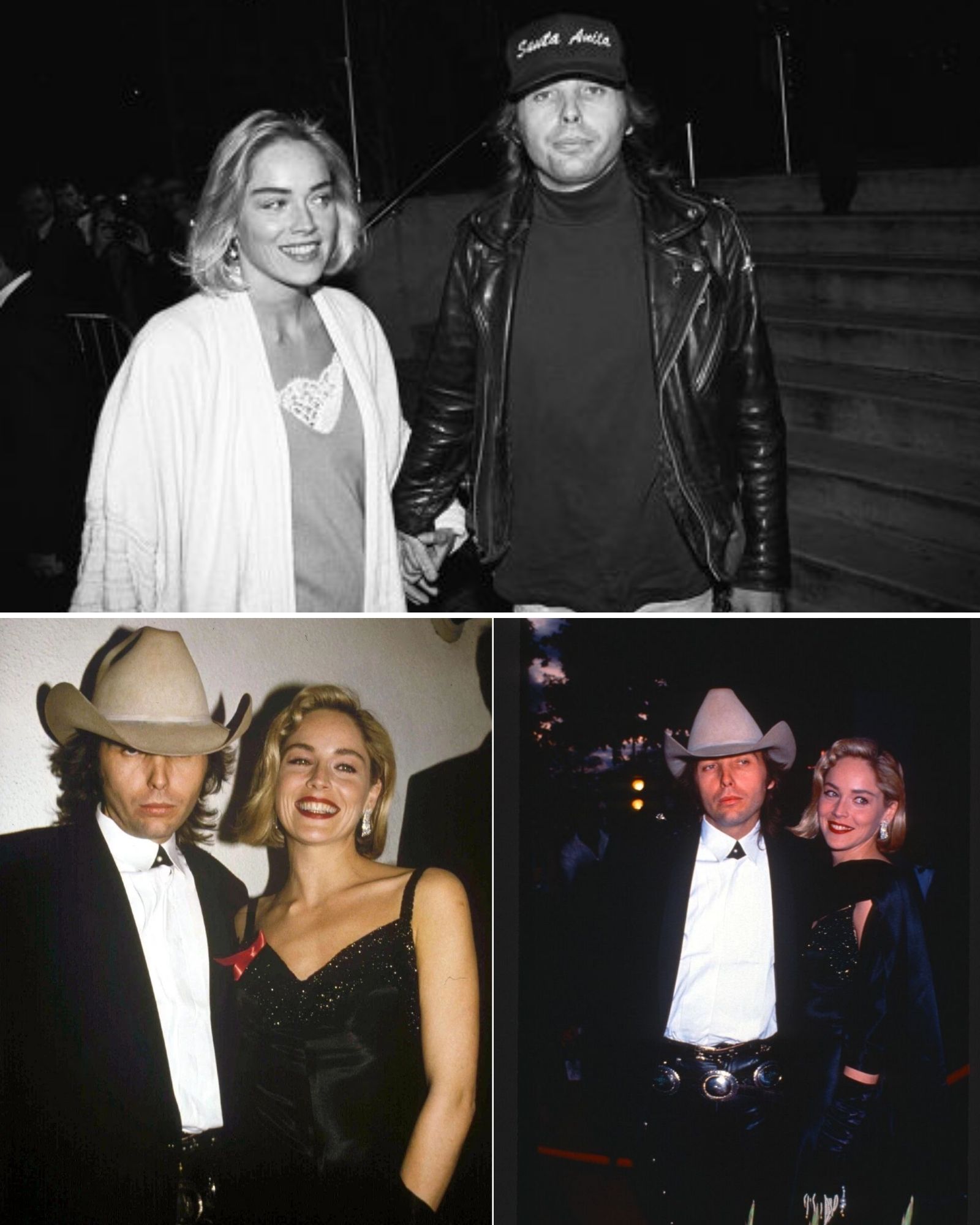
Few insults in entertainment history have traveled as far as the one Sharon Stone aimed at Dwight Yoakam. After their short romance ended, Stone told the press that kissing him was like eating a dirt sandwich, and writers kept repeating it for the rest of the decade. Yoakam never answered in kind. What he put out instead was This Time, a record cut at Capitol Studios in Hollywood with his longtime producer and guitarist Pete Anderson. It became the best-selling album of his life.
Here is how that year unfolded, and what really went on inside those sessions.
Oscar Night, 1992
The romance began just as Sharon Stone’s life changed overnight. Basic Instinct opened on March 20, 1992, only days before the Academy Awards. Stone has said that because the film had not come out yet when she was invited, no designer would lend her a dress for the ceremony.
On March 30, she walked into the Dorothy Chandler Pavilion in Los Angeles with Dwight Yoakam as her date, cowboy hat and all. The photographs went around the world. The relationship itself did not last long. Some accounts measure it in weeks, others in a few months, and neither of them has ever gone into detail about why it ended.
The Line That Would Not Go Away
What outlived the romance was Stone’s verdict on it. The exact wording shifted depending on who printed it. The most repeated version says kissing Yoakam was like eating a dirt sandwich; other reports had her saying she would rather bite into one than get back together with him.
Years later she stood by it. In a 1995 interview with the Orlando Sentinel, she called the line one of her favorites and owned it without hesitation:
“Yes, yes, yes, I said it!”
By then the remark had become a permanent part of Dwight Yoakam’s press clippings. Profiles of him kept bringing it up well into the 2000s, and a 2014 Grantland feature noted that for years he had simply declined to discuss anything about Stone.
The Only Thing He Said
Dwight Yoakam did not trade barbs, give a rival interview or tell his side of the story. The closest he came was a brief remark to the Los Angeles Times, and it pointed the blame back at himself rather than at her:
“I was coming out of a five-year relationship and pretty clumsy about myself emotionally. … We dated.”
That was the whole of it: a few words about his own state of mind, and a flat “we dated” to close the subject.
Inside the This Time Sessions
The record that came out of that stretch, his fifth studio album, was made at Capitol Studios in Hollywood, the same rooms where his previous record had been made. Anderson produced and played electric guitar, with production help from Dusty Wakeman, and he went in with a clear goal. He wanted the record to sound like nobody but Yoakam, the way Johnny Cash records sounded like nothing but Johnny Cash. In his words, “I wanted to get to a point where we made Dwight Yoakam music.”
That meant taking risks. Anderson recorded the album using Pro Tools. Yoakam wrote or co-wrote every song but one, and four of them he built with the songwriter Kostas, a partner who cared as much about sound and texture as about lyrics. The one outside song, “Ain’t That Lonely Yet” by Kostas and James House, got a lush string arrangement from Paul Buckmaster, the arranger known for his work with Elton John.
The biggest gamble was “A Thousand Miles from Nowhere,” a song Yoakam wrote alone. Anderson later called putting it on the album the biggest decision of the whole project, because it sounded unlike anything Yoakam had recorded before. Its long closing guitar passage was inspired by “Layla” by Derek and the Dominos.
Yoakam knew the record was stretching past traditional country. He told Us magazine in 1993 that country was not where he would remain forever, but it would always be the place he came back to.
What the Record Did
This Time arrived on March 23, 1993. Its first three singles, “Ain’t That Lonely Yet,” “A Thousand Miles from Nowhere” and “Fast as You,” each climbed to No. 2 on the Billboard country chart. “Fast as You,” with a circling guitar hook that recalls Roy Orbison’s “Oh, Pretty Woman,” also crossed onto the Hot 100. The album reached No. 4 on the country albums chart and No. 25 on the Billboard 200, and it kept selling until it was certified triple platinum. No other Dwight Yoakam album has sold more.
Over the years, some fans have claimed “Fast as You” was his reply to Stone. It makes a tempting story, but Yoakam has never said so, and nothing in the documented history of the album ties any of its songs to her.
The Same Quiet, Thirty Years Later
Dwight Yoakam kept his personal life just as private for decades. In March 2020, he married photographer Emily Joyce at St. Monica Catholic Church in Santa Monica, with fewer than ten people in attendance, and the couple only shared the news two months later. Their son, Dalton, was born that August. Yoakam turned 70 in October 2026 and is still on the road.
He never did fire back. Do you remember the first time you heard “A Thousand Miles from Nowhere” on the radio?