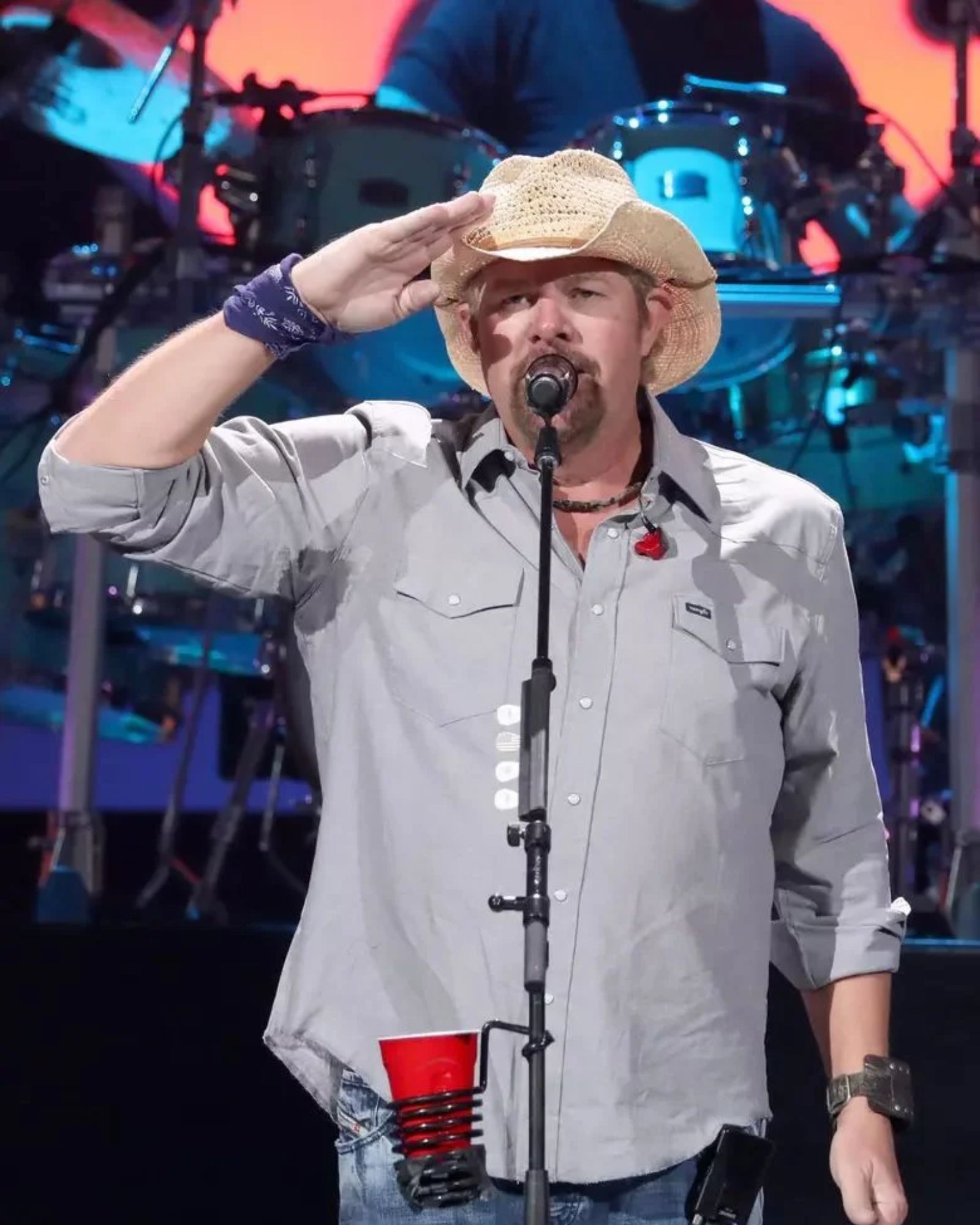
“If you believe in it enough, it’s worth fightin’ for.” — Toby Keith, 2006
When Toby Keith spoke those words during a CBS News interview in September 2006, they weren’t simply another patriotic statement from a country music star. They reflected something Toby Keith had learned growing up in Oklahoma, carried into the recording studio, and eventually put into practice thousands of miles from home.
To understand why those words mattered, you have to go back to the man who taught Toby Keith what the American flag meant in the first place.
The Father Who Taught Toby Keith What to Believe In
Toby Keith’s father, Hubert K. Covel Jr., served in the United States Army during the 1950s and lost an eye during a military training mission. But military service never diminished Hubert K. Covel Jr.’s pride in his country.
At the family home in Oklahoma, the American flag flew every day of the year. Respect for veterans wasn’t something reserved for Memorial Day or the Fourth of July. It was part of everyday life.
For years, Hubert K. Covel Jr. encouraged Toby Keith to visit American troops overseas through the USO. But Toby Keith was performing roughly 130 shows a year, and the trips never fit into the schedule.
On March 24, 2001, Hubert K. Covel Jr. died in a car accident.
Six months later, the September 11 attacks changed America. For Toby Keith, the national tragedy also brought back everything his father had taught him.
The Song Toby Keith Wrote in 20 Minutes
Within days of September 11, Toby Keith sat down with a sheet of fantasy football paperwork and began writing. About 20 minutes later, Toby Keith had created one of the most controversial and recognizable songs of his career.
The song was Courtesy of the Red, White and Blue (The Angry American).
Originally, Toby Keith intended the song for American service members, not as a commercial single. But after performing it for Marines preparing to deploy, Toby Keith was encouraged by military leadership to release it.
The song became a No. 1 country hit in 2002. It also drew fierce criticism for its confrontational lyrics.
Toby Keith understood the controversy. In interviews, Toby Keith acknowledged that the song was not written for everyone. It came from personal grief, anger over September 11, and respect for the military.
But standing behind a controversial song was only one part of what Toby Keith believed.
Then Came a Different Kind of Patriotic Song
In 2003, Toby Keith released American Soldier, co-written with Chuck Cannon.
Unlike the defiant message of Courtesy of the Red, White and Blue, this song focused on the everyday lives of military personnel: raising families, working ordinary jobs, and accepting responsibilities that could take them far from home.
On February 21, 2004, American Soldier reached No. 1 on Billboard’s country chart and remained there for four weeks.
For military families, the song became more than another radio hit. It acknowledged the people behind the uniforms and the sacrifices their families shared.
And Toby Keith was about to demonstrate that appreciation in a much more personal way.
Beyond the Music: The Promise That Became a Mission
Beginning in 2002, Toby Keith traveled with the USO to perform for American troops overseas. The journeys took Toby Keith to Iraq, Afghanistan, Bosnia, Kosovo, and numerous other locations.
Some performances took place at large military installations. Others brought Toby Keith to small, isolated outposts where service members rarely received visits from entertainers.
By September 2014, the USO reported that Toby Keith had entertained more than 250,000 service members in 17 countries, performing nearly 300 shows.
There was another contribution that received far less publicity.
During visits to Afghanistan, Toby Keith recognized that service members at remote bases lacked many everyday comforts. That observation helped inspire USO2GO, a program delivering entertainment equipment, snacks, and other comforts to military personnel stationed far from major USO centers.
Toby Keith wasn’t only giving troops a concert. Toby Keith was helping make their daily lives a little easier.
In April 2014, Toby Keith received the Spirit of the USO Award in recognition of that commitment.
The Meaning Behind Those Words
There was something important about Toby Keith’s patriotism that often got overlooked. Toby Keith openly questioned aspects of the Iraq War while maintaining support for the men and women ordered to serve.
For Toby Keith, respecting soldiers did not require agreeing with every political decision. It meant recognizing their service and showing appreciation in person.
When Toby Keith died on February 5, 2024, at age 62, millions remembered the black cowboy hat, the unmistakable voice, and songs that had become part of American country music.
But the military personnel who saw Toby Keith arrive at their bases had another reason to remember.
Toby Keith believed that honoring American service members was worth the effort, the travel, and the time away from home.
And that brings everything back to those words from 2006:
“If you believe in it enough, it’s worth fightin’ for.”
Toby Keith didn’t merely record songs about that belief. Through years of visits, hundreds of performances, and practical support for service members, Toby Keith gave those words a meaning that lasted long after the music stopped.